Rolex
Explorer II
1655
The original Explorer II — bold orange hand, uncompromising purpose.
An estimate from current market data — not an offer. Your actual value depends on condition, completeness, and authentication.
Get an instant offerFree insured shipping. Paid within 48 hours of inspection.
Overview
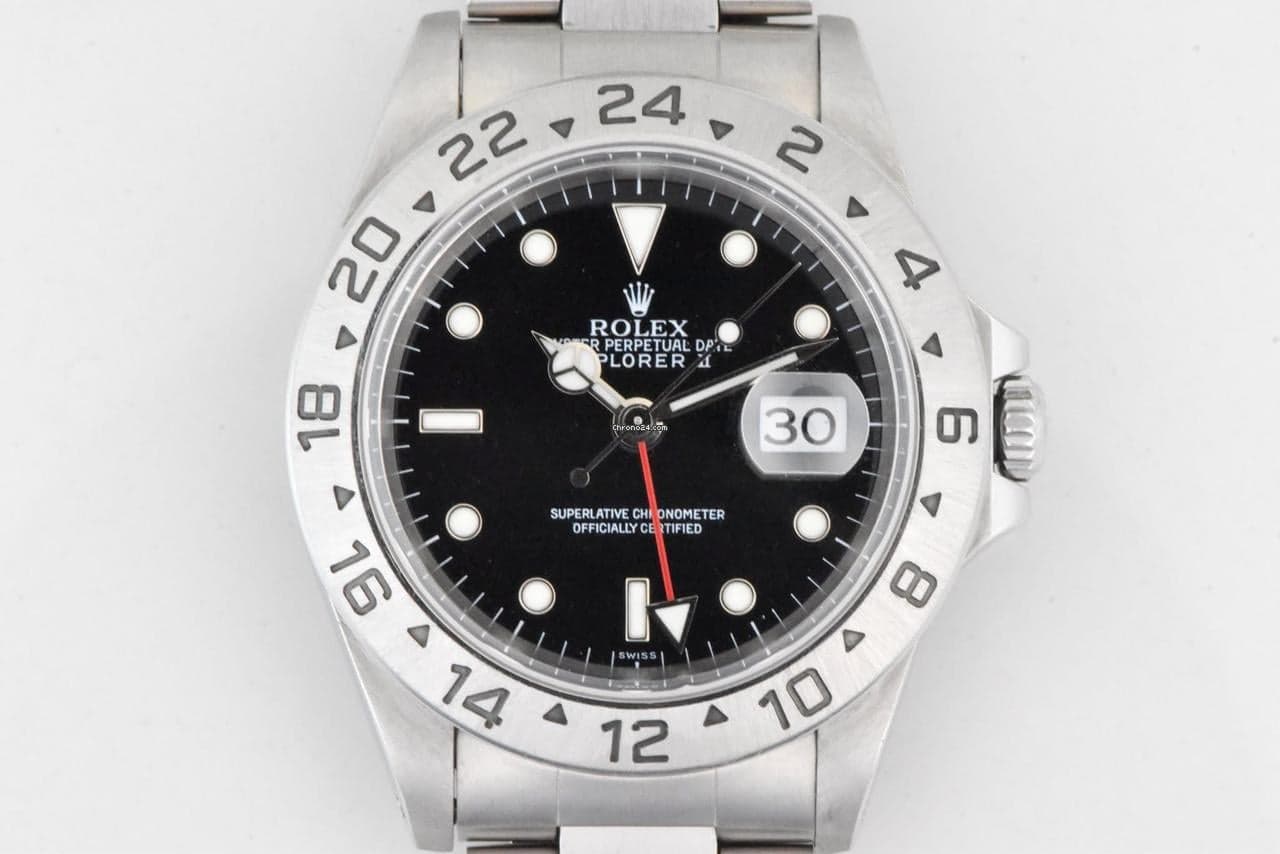
The Rolex Explorer II reference 1655 stands as the founding expression of the Explorer II line, introduced in 1971 to serve spelunkers, cavers, and polar explorers who needed to distinguish day from night in environments without natural light. Its defining feature is a fixed 24-hour bezel paired with a distinctive orange arrow-tipped hand that completes one full rotation every 24 hours. Housed in a 39 mm stainless steel case, the reference remained in production until 1985, earning a devoted following among collectors of vintage Rolex sport references.
History
The 1655 debuted at a time when Rolex was expanding its professional sport lineup beyond the established Explorer and Submariner families, targeting a new category of scientific and expedition professionals. Powered by the automatic calibre 1575 — a robust movement derived from the cal. 1570 base — the watch offered reliable timekeeping in demanding conditions. Over its roughly fourteen-year production run the reference saw subtle dial and hand variations, including the evolution of the orange hand's lume plots, details that today form the basis of careful collector dating. Its long tenure before being succeeded by the reference 16550 cemented its status as a genuine tool-watch icon of the 1970s and early 1980s.
Notable points
- The fixed stainless steel 24-hour bezel — not a rotating one — was purpose-designed to help users in sunless environments read AM from PM at a glance.
- The vivid orange 24-hour arrow hand, often called the 'Freccione' (big arrow) by Italian collectors, is the reference's most immediately recognisable signature.
- Calibre 1575 is a self-winding movement with a quickset-adjacent lineage, though the 1655 itself did not feature a quickset date function.
- Dial and hand variations across the production run — including changes to lume plots and the precise shade of orange — provide collectors with a nuanced chronology for authenticating and dating individual examples.
- The 1655 is widely regarded as the watch that established the Explorer II as a distinct and serious professional instrument, separate in identity from the original Explorer line.